- Town of Danville, Calif. – Official Website
- Town Government
- Police Services
- Electric Bikes and Scooters
Electric Bikes and Scooters
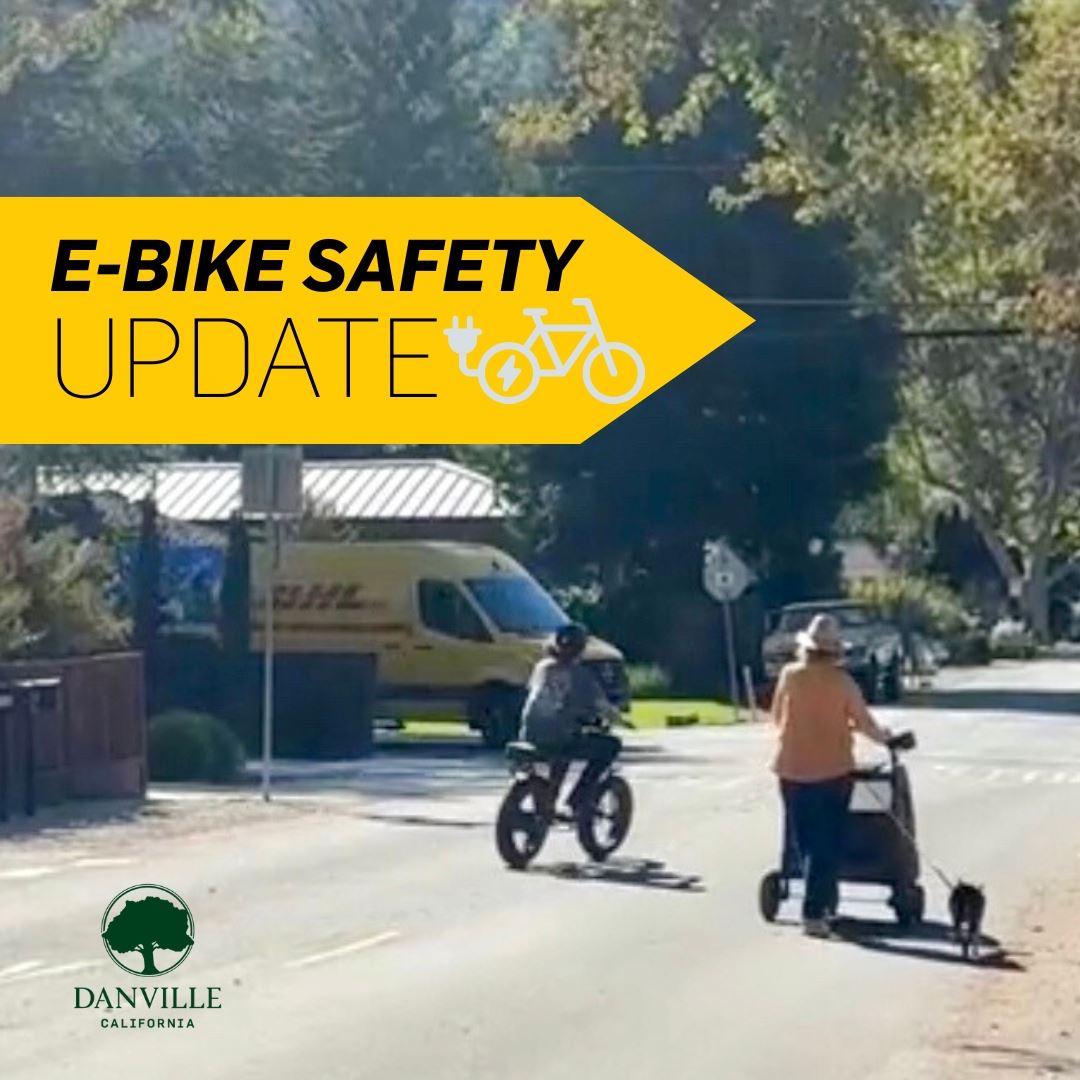 Danville Town Council Leads Public Study Session on E-Bike Safety
The Town Council held a study session July 8 to address growing community concerns regarding e-bike safety, including information on what local officials can — and cannot — do to regulate use of e-bikes and motorcycles according to state law.Read on...
- Do I need a license to ride an e-bike or e-scooter?
-
E-bikes:
- Class 1 & 2: No license required
- Class 3: Riders must be at least 16, but no license is required (CVC §21213(a))
E-scooters:
- Yes, you must have a valid driver’s license or learner’s permit to operate an e-scooter in California (CVC §21235(d))
- Can kids ride e-bikes or scooters?
-
- E-bikes:
- Class 1 & 2: No minimum age by law, but children should be knowledgeable of the rules of the road
- Class 3: Minimum age is 16 (CVC §21213(a))
- E-scooters:
- Riders must be old enough to obtain a driver’s permit or license
- E-bikes:
- What happens if I break the rules?
-
Violating California or local laws (e.g., speeding, riding on sidewalks, riding without a license) can result in citations, fines, and in some cases, impoundment of the device. Town of Danville police enforce these rules for public safety.
- Can the Town of Danville ban all e-bikes or e-scooters from public roads?
-
No. The Town of Danville cannot ban e-bikes or e-scooters from public streets or roadways because state law classifies them as legal vehicles with a right to use the road, just like bicycles. California Vehicle Code (CVC) defines where and how e-bikes and e-scooters can be operated statewide. Local jurisdictions may regulate their use on certain paths, sidewalks, or trails, but they cannot pass ordinances that override or contradict the state’s vehicle code. (CVC §21207.5, CVC §21230)
 CHP Safety Training Course
The California Highway Patrol (CHP) has created a free online electric bicycle safety course to help protect commuters and recreational riders. The Town of Danville strongly encourages all e-bike users to complete this course before utilizing their vehicle.
 California E-Bike Incentive Project Training Course
The California E-Bike Incentive Project is a partnership between California Air Resources Board and Pedal Ahead, a non-profit organization. Their video-based training covers e-bike equipment as well as safe riding.
Which E-Bike Is Right for Your Family?
This short quiz aligns with local and state regulations to help you match the e-bike with the rider.
What is an E-Bike or E-Scooter?
E-bikes are almost like regular bikes. An electric bicycle is a bicycle equipped with fully operable pedals and an electric motor of less than 750 watts. California Vehicle Code VEH 312.5 (see California Bike and Scooter Laws) defines three classes of electric bicycles based on their top assisted speed and whether the motor assists only while pedaling.
- Class 1: Pedal-assist only (no throttle), with a maximum assisted speed of 20 mph.
- Class 2: Throttle-assisted or pedal-assisted, with a maximum speed of 20 mph (with or without pedaling).
- Class 3: Pedal-assist only (no throttle), with a maximum assisted speed of 28 mph, and must be equipped with a speedometer. Riders must be at least 16 years old and wear a helmet.
- The same rules of the road that apply to human-powered bicycles apply to all types of e-bikes and human-powered bicycles
- Electric bicycles do not need registration, licensing or insurance like a car or motorcycle
An e-scooter is a motorized scooter that typically consists of two wheels, handlebars, and a standing floorboard.
- In California, e-scooter users must have a valid driver's license or permit
- The same rules of the road that apply to human-powered bicycles and e-bikes apply to all e-scooters as well
E-Scooters
Rider Requirement
- Valid driver's license or permit
- Helmet required for 17 and under
Where You Can Ride
- Bike lane
Riding Rules
- Maximum speed of 15 mph
- Only one rider at a time
Class 1 & 2 E-Bikes
Rider Requirement
- No minimum age
- No driver's license
- Helmet required for 17 and under
Where You Can Ride
- Class 1: Bike lane & trails
- Class 2: Bike lane & trails
Regulation Rules
- Maximum speed 20 mph
- Pedal assist only (Class 1)
- Pedal and throttle assist (Class 2)
Class 3 E-Bikes
Rider Requirement
- Minimum age 16
- No driver's license
- Helmet required for all ages
Where You Can Ride
- Class 3: Bike lane
Regulation Rules
- Maximum speed 28 mph
- Pedal assist
Motorized Bicycle/Moped
Rider Requirement
- M1 or M2 driver's license or permit required
- Vehicle must be registered with the state
- Helmet required for all ages
Where You Can Ride
- Bike lane
Riding Rules
- Maximum speed of 30 mph
Motor-Driven Cycle
Rider Requirement
- M1 driver's license or permit required
- Vehicle must be registered with the state
- Helmet required for all ages
Where You Can Ride
- Bike lane
Riding Rules
- Maximum speed of 60 mph
Dirt Bike/Off-Highway Vehicle
Rider Requirements
- No driver's license
- Off-highway vehicle registration required with the state
- Helmet required for all ages
Where You Can Ride
- May be used in State Vehicular Recreation Areas and National Forests
- Cannot be used on public roads
Riding Rules
- Maximum speed varies
In the Town of Danville, it is illegal for anyone to ride an electric bicycle, electric skateboard, or electric scooter on the sidewalk in any business district. |
| When selecting an e-bike or e-scooter for your child, or when enjoying motorized bikes yourself, it’s important to know the state and local laws that govern use of different classes of bikes and scooters. Rules and definitions outlined by the California Vehicle Code (CVC) for each type of bike and scooter are noted here. In the Town of Danville, it is illegal for anyone to ride any electric bicycle, electric skateboard, or electric scooter on the sidewalk in any business district, including in "mixed-use areas" and "commercial" areas in this map. |
Below are the definitions of e-bikes and e-scooters as outlined in the California Vehicle Code, the set of laws that govern the operation, ownership, and registration of vehicles in the state.
An “electric bicycle” is a bicycle equipped with fully operable pedals and an electric motor of less than 750 watts <312.5. (a)>.
- (1) A “class 1 electric bicycle,” or “low-speed pedal-assisted electric bicycle,” is a bicycle equipped with a motor that provides assistance only when the rider is pedaling, and that ceases to provide assistance when the bicycle reaches the speed of 20 miles per hour.
- (2) A “class 2 electric bicycle,” or “low-speed throttle-assisted electric bicycle,” is a bicycle equipped with a motor that may be used exclusively to propel the bicycle, and that is not capable of providing assistance when the bicycle reaches the speed of 20 miles per hour.
- (3) A “class 3 electric bicycle,” or “speed pedal-assisted electric bicycle,” is a bicycle equipped with a motor that provides assistance only when the rider is pedaling, and that ceases to provide assistance when the bicycle reaches the speed of 28 miles per hour, and equipped with a speedometer.
- (b) A person riding an electric bicycle, as defined in this section, is subject to Article 4 (commencing with Section 21200) of Chapter 1 of Division 11.
- (c) On and after January 1, 2017, manufacturers and distributors of electric bicycles shall apply a label that is permanently affixed, in a prominent location, to each electric bicycle. The label shall contain the classification number, top assisted speed, and motor wattage of the electric bicycle, and shall be printed in Arial font in at least 9-point type.
A “motorized scooter” is any two-wheeled device that has handlebars, has either a floorboard that is designed to be stood upon when riding or a seat and footrests in place of the floorboard, and is powered by an electric motor <407.5. (a)>.
Vehicle
| Vehicle Type | Pedal Operated | Maximum Assisted-Speed (MPH) |
|---|---|---|
| Class 1 E-Bike | Yes | 20 |
| Class 2 E-Bike | No | 20 |
| Class 3 E-Bike | Yes | 28 |
| E-Scooter | No | 15 |
Rider
| Vehicle Type | Minimum Age (Years) | Driver's License | License Plate | Helmet |
|---|---|---|---|---|
| Class 1 E-Bike | n/a | No | No | 17 and under |
| Class 2 E-Bike | n/a | No | No | 17 and under |
| Class 3 E-Bike | 16 | No | No | All users |
| E-Scooter | 15.5 with driver's permit | Yes | No | 17 and under |
Riding Access
| Vehicle Type | Bike Lane | Iron Horse Trail | Business District Sidewalks |
|---|---|---|---|
| Class 1 E-Bike | Yes | Yes | No |
| Class 2 E-Bike | Yes | Yes | No |
| Class 3 E-Bike | Yes | No | No |
| E-Scooter | Yes | No | No |
Below are rules pertaining to e-bikes and e-scooters as outlined by the California Vehicle Code, the set of laws governing the operation, ownership, and registration of vehicles within the state.
E-Bikes
- 21207.5 (a) A motorized bicycle or class 3 electric bicycle shall not be operated on a bicycle path or trail, bikeway, bicycle lane established pursuant to Section 21207, equestrian trail, or hiking or recreational trail, unless it is within or adjacent to a roadway or unless the local authority or the governing body of a public agency having jurisdiction over the path or trail permits, by ordinance, that operation.
- 21213 (a) A person under 16 years of age shall not operate a class 3 electric bicycle
(b) A person shall not operate a class 3 electric bicycle, or ride upon a class 3 electric bicycle as a passenger, upon a street, bikeway, as defined in Section 890.4 of the Streets and Highways Code, or any other public bicycle path or trail, unless that person is wearing a properly fitted and fastened bicycle helmet that meets the standards of either the American Society for Testing and Materials (ASTM) or the United States Consumer Product Safety Commission (CPSC), or standards subsequently established by those entities. This helmet requirement also applies to a person who rides upon a class 3 electric bicycle while in a restraining seat that is attached to the bicycle or in a trailer towed by the bicycle. 21211 Bike path obstruction: No one may stop on or park a bicycle on a bicycle path. - 21212 (a) A person under 18 years of age shall not operate a bicycle, a nonmotorized scooter, or a skateboard, nor wear in-line or roller skates, nor ride upon a bicycle, a nonmotorized scooter, or a skateboard as a passenger, upon a street, bikeway, as defined in Section 890.4 of the Streets and Highways Code, or any other public bicycle path or trail unless that person is wearing a properly fitted and fastened bicycle helmet that meets the standards of either the American Society for Testing and Materials (ASTM) or the United States Consumer Product Safety Commission (CPSC), or standards subsequently established by those entities. This requirement also applies to a person who rides upon a bicycle while in a restraining seat that is at 21651.
- 21651 (b) It is unlawful to drive any vehicle upon a highway, except to the right of an intermittent barrier or a dividing section which separates two or more opposing lanes of traffic. Except as otherwise provided in subdivision (c), a violation of this subdivision is a misdemeanor. 10.56.010 (CMC) Riding on sidewalks and public facilities. No person shall ride a bicycle upon any sidewalk, in any public drainage facility, culvert, ditch, or channel; or any other public athletic/sports courts, or gymnasiums in the city. Law enforcement personnel shall be exempt from the provision of this section when in the performance of their duties. (Ord. CS-139 § 1, 2011; Ord. NS-151 § 1, 1991; Ord. 3062 § 8). (Look at 21663 CVC as well)
E-Scooters
(California Vehicle Code §21235) The operator of a motorized scooter shall not do any of the following:
- (a)Operate a motorized scooter unless it is equipped with a brake that will enable the operator to make a braked wheel skid on dry, level, clean pavement.
- (b)Operate a motorized scooter on a highway with a speed limit in excess of 25 miles per hour unless the motorized scooter is operated within a Class II or Class IV bikeway, except that a local authority may, by ordinance or resolution, authorize the operation of a motorized scooter outside of a Class II or Class IV bikeway on a highway with a speed limit of up to 35 miles per hour. The 15 mile per hour maximum speed limit for the operation of a motorized scooter specified in Section 22411 applies to the operation of a motorized scooter on all highways, including bikeways, regardless of a higher speed limit applicable to the highway.
- (c)Operate a motorized scooter without wearing a properly fitted and fastened bicycle helmet that meets the standards described in Section 21212, if the operator is under 18 years of age.
- (d)Operate a motorized scooter without a valid driver’s license or instruction permit.
- (e)Operate a motorized scooter with any passengers in addition to the operator.
- (f)Operate a motorized scooter carrying any package, bundle, or article that prevents the operator from keeping at least one hand upon the handlebars.
- (g)Operate a motorized scooter upon a sidewalk, except as may be necessary to enter or leave adjacent property.
- (h)Operate a motorized scooter on the highway with the handlebars raised so that the operator must elevate his or her hands above the level of his or her shoulders in order to grasp the normal steering grip area.
- (i)Leave a motorized scooter lying on its side on any sidewalk, or park a motorized scooter on a sidewalk in any other position, so that there is not an adequate path for pedestrian traffic.
- (j)Attach the motorized scooter or himself or herself while on the roadway, by any means, to any other vehicle on the roadway.
Danville Municipal Code
4-19 ELECTRIC BICYCLES AND MOTORIZED SCOOTERS ON SIDEWALKS.
4-19.1 Definitions.
For purposes of this chapter, the following words and phrases shall have the meanings defined in this section:
Business district shall mean that portion of a highway and the property contiguous thereto (a) upon one side of which highway, for a distance of 600 feet, 50 percent or more of the contiguous property fronting thereon is occupied by buildings in use for business, or (b) upon both sides of which highway, collectively, for a distance of 300 feet, 50 percent or more of the contiguous property fronting thereon is so occupied (CVC Section 235).
Electric bicycle shall mean a bicycle equipped with fully operable pedals and an electric motor of less than 750 watts (CVC Section 312.5).
Electrically motorized board shall mean any wheeled device that has a floorboard designed to be stood upon when riding that is not greater than 60 inches deep and 18 inches wide, is designed to transport only one person, and has an electric propulsion system averaging less than 1,000 watts, the maximum speed of which, when powered solely by a propulsion system on a paved level surface, is no more than 20 miles per hour. The device may be designed to also be powered by human propulsion (CVC Section 313.5).
Motorized scooter shall mean any two-wheeled device that has handlebars, has either a floorboard that is designed to be stood upon when riding or a seat and footrests in place of the floorboard, and is powered by an electric or other motor. This device may also be designed to be powered by human propulsion (CVC Section 407.5).
Sidewalk shall mean that portion of a highway, other than the roadway, set apart by curbs, barriers, markings or other delineation for pedestrian travel (CVC Section 555).
(Ord. 2024-07, § 1 (part))
4-19.2 Prohibited Activity.
Pursuant to the authority of Vehicle Code Sections 21206, 21967 and 21968, it shall be unlawful for any person to ride an electric bicycle, electrically motorized board or motorized scooter on a sidewalk within a business district in the Town of Danville.
(Ord. 2024-07, § 1 (part))